



Industrial PTFE Hoses
Industrial PTFE Hoses
Thunder Technologies assembles and tests your PTFE hoses in our facility for fast delivery.
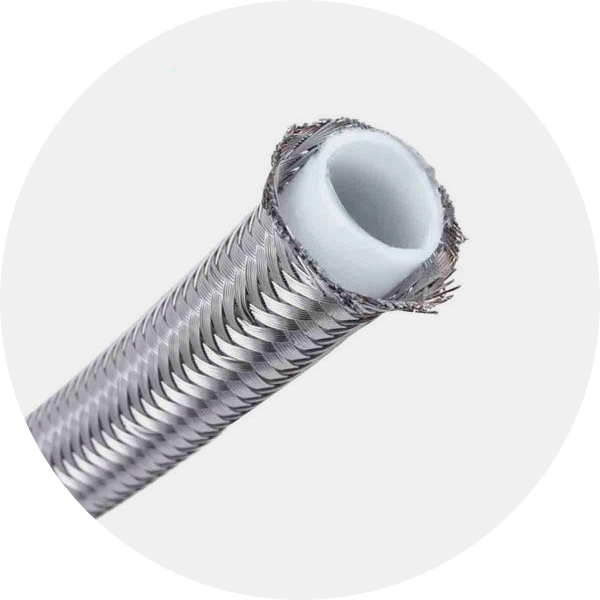
PTFE hoses refer to hoses that have a PTFE liner and a braided or rubber cover. Conductive PTFE hoses have a black conductive PTFE core to handle media that has static electricity issues. Non-conductive PTFE hoses have a white non-conductive PTFE core. The type of cover on your PTFE hose depends on how you are using your hose. The most common PTFE hoses are steel braided PTFE hoses and rubber-covered PTFE Hoses.
PTFE Hoses are a superior choice for Chemical hoses and sanitary hose requirements.
The hose end fittings for your PTFE hoses are attached using swaging or crimping processes.
Couldn't load pickup availability
- Additional Info
Characteristics of PTFE Hoses
- Sizes: 3/16″ – 6″ ID
- Length: Custom to your PTFE hose assembly specification
- Temperature range: -100 F to 450 F
- Pressure range: Up to 5000 PSI
- Full-Vacuum
- Covers: Stainless Steel Braiding; Polypropylene Braiding; Kynar; Silicone & EPDM rubber, including custom EPDM colors; Stainless Armor
- Fittings: PTFE lined or unlined fittings available to your specification for your PTFE hoses. Fittings can be made of brass, stainless steel, hastelloy, carbon steel or Titanium. Standard and custom fitting configurations available.
- Conductivity: Conductive (black) and non-conductive (white) PTFE hose assemblies availabl
- Styles: Smoothbore and Convoluted (corrugated) PTFE linings available for your PTFE hoses
Features of PTFE Hoses
- Medium and High Pressure PTFE Hoses
- Chemically Resistant: PTFE hose assemblies handle an endless variety of fluids
- Chemically Inert: PTFE hoses will not break down or deteriorate in service
- Superior clean ability
- Strong and Flexible PTFE hoses withstand vibration, and flexing
Ideal Applications For PTFE Hoses
- Chemical hoses
- Chlorine hose
- Bromine hoses
- Steam hoses
- Acid hoses
- Bleach hoses
- Natural gas hose
- Oil transfer hose
- Pump hoses
- Pump connectors
- High pressure hoses
- Fuel hoses
- Coolant hose
- Solvent hose
- Alcohol hose
- Pharmaceutical hoses
- Paint hoses
- Compressed Natural Gas (CNG) hoses
Thunder Technologies’ Services For Rubber Hoses
- ID Tagging can help track your PTFE hoses from “cradle to grave”
- Leak Testing and certification available for your PTFE hoses
- Add a Gasket and we can test your Continental rubber hose assembly as a complete-set
PRICING & AVAILABILITY
We Look Forward to Working With You
DON’T SEE WHAT YOU NEED? CALL US. WE CAN FIND IT FOR YOU!
We accept Visa, MasterCard, American Express & Discover for your convenience.
Industrial PTFE Hoses
Features and Characteristics
- Sizes: ¼” – 16″ ID
- Length: Custom to your metal hoses’ specifications
- Temperature range: -320°F to 1500°F
- Pressure range: Up to 6000 psi
- Fittings: Standard and custom fittings welded to your metal hose assembly, including Titanium fittings
- Cover: With or without a stainless steel braided hose cover. We can also add an EPDM rubber cover for color coding or operator safety from extreme temperatures
- Materials: 321 & 316 Stainless Steel; and specialty metals including Hastelloy, Monel, and Inconel
- Helical, Annular, Strip wound, Interlocked metal hose liners available
- Tubular and braided metal hose styles are available
Applications
- Flexline flexible metal hoses
- Expansion joints
- Fuel Cell hoses
- Gas turbine hoses
- Chemical metal hoses
- Cryogenic metal hoses
- Coolant hoses
- Natural Gas hoses
- Pump hoses
- Pump connectors
- Steam Hose
- Alcohol Hose assemblies
- Solvent hose assemblies
- Bleach hose assembly
- High Temperature hoses
Welding Procedures
Your flexible metal hoses are welded together and then helium leak tested with a mass spectrometer if requested. Further radiography or x-ray testing, dye penetrate testing and cleaning is available.You can be confident that, because of superior fabricating welding procedures, and helium leak testing capabilities, your flexible metal hoses are the highest quality for your critical application.
Our flexible metal hoses are used by the Navy, NASA, nuclear and power generation, military contractors, pharmaceutical manufacturers, and chemical manufacturers. Every hose fabricator will tell you that they make quality hose assemblies. But Thunder Technologies hoses are made with state-of-the-art procedures and testing capabilities.
The Right Way to Test Flexible Metal Hoses
Did You Know . . . . All metal hoses leak!
The ONLY way to accurately leak test your metal hoses is by using helium and a mass spectrometer to determine your leak rate. Most fabricators do not have mass spectrometers, so instead, they will test your hose by putting it into a bucket of water and eyeball it for bubbles.You want to know your metal hose’s leak rate.
Your flexible metal hose can be tested with a mass spectrometer so we can give you the exact leak rate of your metal hoses. Unless your specs require a more stringent leak rate, your metal hose will be tested at a leak rate of 10 -8, or a leak rate of about 1 drop of fluid per year.Testing metal hose assemblies in a bucket of water DOES NOT give you the leak rate for your critical metal hose requirements. This inferior metal hose leak testing is not uncommon among metal hose fabricators.
“Any quotes? Spend some time thinking and make it memorable”